.png)
Follow Us!


Public Health Chronicle
Latest public health news and updates of the world
Public Health News Analysis
Alcohol and the need for public health interventions

Content Editor : Dr. Urmimala Maiti
Updated on :
March 8, 2023
Alcohol Consumption, NFHS-5, Public Health Interventions
The National Family Health Survey-5 (NFHS-5) for 2019-21 revealed that nearly 15 crore people (over 15 years of age) consume alcohol in India (1.3% of women and 18.8% of men).
This column is an analysis based on the article in The Tribune, “Alcohol's cancer risk calls for policy review” by Rakesh Kochhar, former President of the Indian Society of Gastroenterology.
The Global Burden of Disease Study (GBD) 2016 Alcohol Collaborators demonstrate the larger than previously estimated contribution of alcohol to ill health, disability and death globally.(1) Alcohol consumption contributed 3 million deaths in 2016 globally and was responsible for 5.1% of the global burden of disease and injury.
The National Family Health Survey-5 (NFHS-5) for 2019-21 revealed that nearly 15 crore people (over 15 years of age) consume alcohol in India (1.3% of women and 18.8% of men).
Consequences of alcohol use
Alcohol is one of the most important reasons for peptic ulcer disease, hemorrhagic gastritis, cancer of the pharynx, oral cavity, esophagus and larynx, lower bone mineral density, neurological and psychological illnesses, domestic violence, economic and family finances leading to crimes, road traffic accidents, to name a few.
There is enough evidence to say that, at low levels of alcohol intake, the increased risk of adverse health outcomes outweighs small reductions in health-related problems.(2)
Public Health Policies
The World Health Organization action plan (2022-2030) was endorsed by the 75th World Health Assembly in May 2022 to effectively implement the global strategy to reduce the harmful use of alcohol as a public health priority.
In India, alcohol policy is a subject of the state. Over time there are fluctuations in its prohibition at the policy level in different states.
The major reason for this is that states generate nearly 15% to 20% of the revenue from alcohol taxation, contributing a significant amount to the state treasury. Also, its ban leads to an increase in illicit liquor and substance abuse.(2)
What more can be done
In the long run, the economic burden of consequences of alcohol consumption far outweighs the benefit of revenue generation.(2)
At the policy level
Research shows that higher alcohol prices reduce alcohol misuse and related harms (e.g., alcohol-related road traffic accidents). All forms of alcohol advertisements, including surrogate ones, should be prohibited.
At community level
Alcohol Use Disorders Identification Test (AUDIT) is a validated 10-item screening tool that can be used to identify the risk of alcohol consumers from low to harmful/hazardous to alcohol dependence.
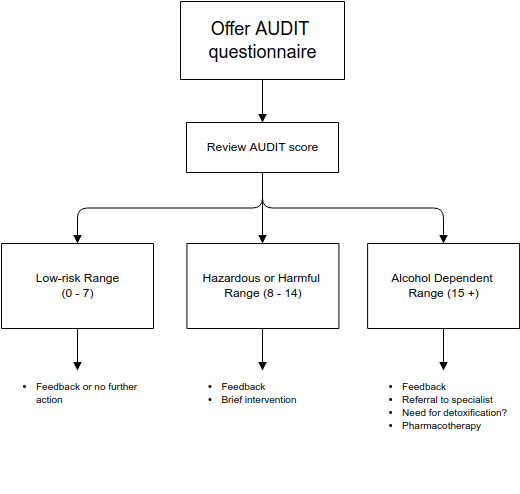
Its use in a primary care setting, to discern those requiring brief interventions from those requiring referral for specialist treatment can be a core step. Brief interventions can be performed by a general practitioner.
They involve one-to-one counselling which can help at-risk drinkers and those with mild alcohol-related problems. Those with higher scores (more than 8) might require pharmacotherapy or referral.
Despite all this, people would still drink
To effectively prevent substance misuse, it is important to understand the nature of the problem. The likelihood of substance abuse, most of the time, begins in adolescence and then increases with age, continuing throughout the lifespan.(3)
Mechanisms of both positive and negative reinforcement play important roles in maintaining individual drinking behaviour. In any consumption practice culture plays an important role. Alcohol has become an inevitable component of socialisation.(3)
Research shows that anti-choice, resistant alcohol behaviour and moral structure affect decision-making for not choosing to consume alcohol despite societal pressures. Hence, awareness about the consequences of alcohol consumption at an early life for example school level, peer education among adolescents can be an important prevention strategy, to develop the above qualities.(3)
Alternative social/recreational activities can help change the culture of social drinking.(5)
Policies exist, but their effective implementation is the need of the hour.
References
Burton R, Sheron N. No level of alcohol consumption improves health. The Lancet. 2018 Sep 22;392(10152):987-8.
Eashwar VMA, Umadevi R, Gopalakrishnan S. Alcohol consumption in India- An epidemiological review. J Family Med Prim Care. 2020 Jan 28;9(1):49-55.
Abuse S, US MH, Office of the Surgeon General (US. PREVENTION PROGRAMS AND POLICIES. Infacing addiction in America: the surgeon General's report on alcohol, drugs, and health [Internet] 2016 Nov. US Department of Health and Human Services.
Fry ML. Discourses of consumer's alcohol resistant identities. Journal of Nonprofit & Public Sector Marketing. 2011 Oct 1;23(4):348-66.
Santini ZI, Nielsen L, Hinrichsen C, Tolstrup JS, Vinther JL, Koyanagi A, Donovan RJ, Koushede V. The association between Act-Belong-Commit indicators and problem drinking among older Irish adults: Findings from a prospective analysis of the Irish Longitudinal Study on Ageing (TILDA). Drug and Alcohol Dependence. 2017 Nov 1;180:323-31.